

You bought a call on SPY, and the stock rose over the next five days. You opened your account and found the option at a loss.
Your direction was not wrong. But time was working against you every day, and this article explains how to measure it before you buy.
What do you pay for with an option?
An option's price has two parts: intrinsic value, if the stock is already past the strike, and time value, which is the price of the time left.
An option that has not reached its strike yet is all time value. That value shrinks every day until it reaches zero at expiration. The amount it loses per day is measured by theta.
A worked example
SPY at $760. A call with a 770 strike expires in 14 days, with implied volatility (IV) of 14%. It is priced at $4.68, or $468 per contract.
Here is its value after five days, depending on how the stock moves:
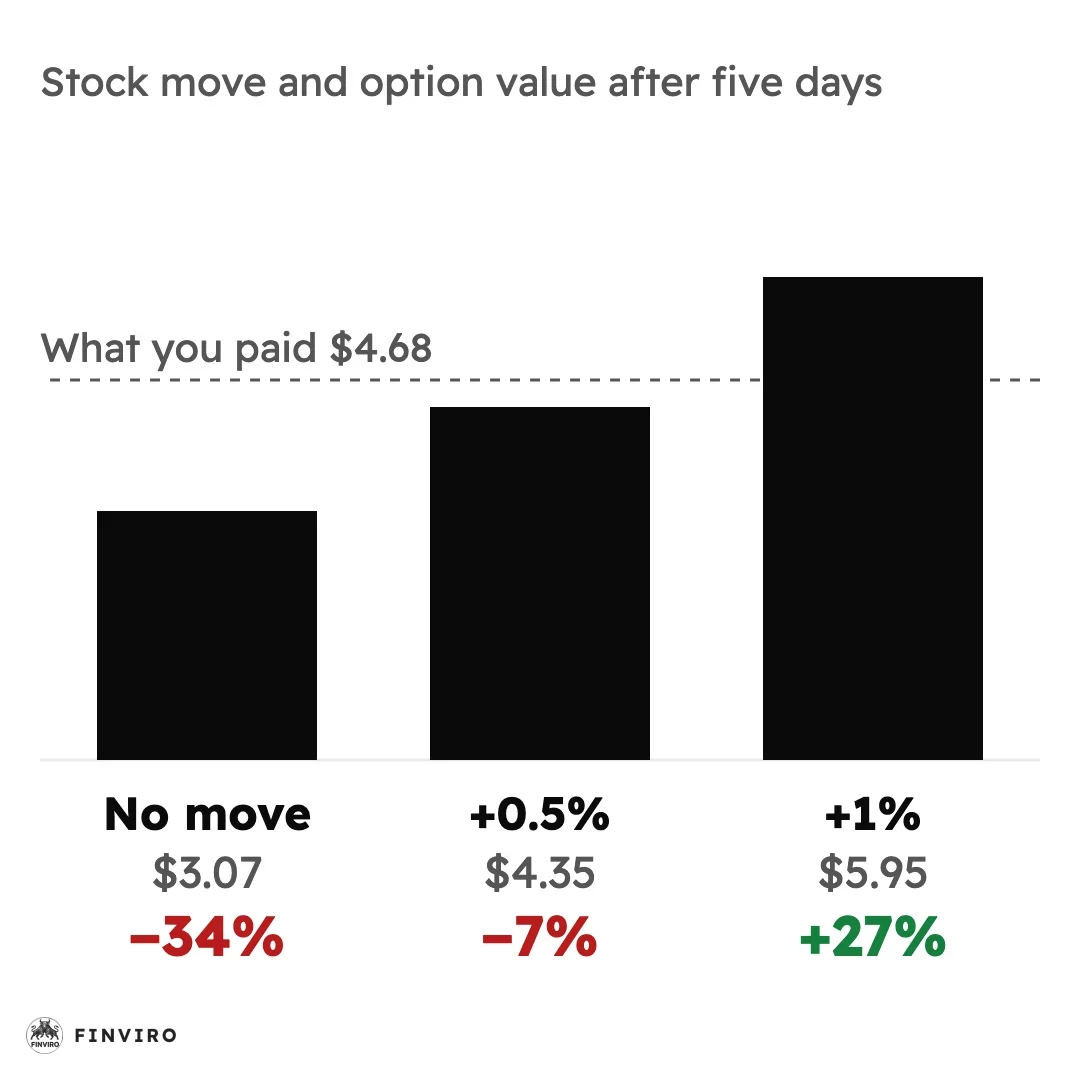
Direction alone is not enough: a 770 call on SPY at $760 expiring in 14 days, and its value after five days depending on how the stock moves. A worked example, not live prices.
| The stock after five days | Option value | Change |
|---|---|---|
| $760, no move | $3.07 | −34% |
| $763.80 (+0.5%) | $4.35 | −7% |
| $767.60 (+1%) | $5.95 | +27% |
A 0.5% rise was not enough. In this example the stock needs about 0.61% in five days just for the option to hold its price.
Why does decay speed up near expiration?
Time does not run out at the same pace every day. An at-the-money option with 60 days left loses, in its final week, about 31% of its original price.
That is why an option close to expiration loses faster, even if the price stays flat.
Three questions about time before you buy
- How many days until expiration? Compare that with how long you expect the move to take.
- What is the theta? In the example it is about $0.30 a day on an option priced at $4.68, or roughly 7% on the first day.
- What move makes up for time? Work out how far the stock has to move for the option to hold its price over the period you have in mind.
What do traders compare?
- More time: the daily decay is slower, and the option costs more.
- An in-the-money option: part of its price is intrinsic value, which does not decay with time.
- A debit spread: the option you sell decays too, which softens the effect of time on the whole trade.
Summary
- An out-of-the-money option is all time value, and time runs down every day.
- The right direction is not enough if the move comes slower or smaller than the option needs.
- Work out theta and the move that makes up for it before you buy, not after.
What comes after this lesson?
Next lesson in the series: Volatility crush after earnings (IV Crush).
To go deeper: delta and theta in the Finviro Academy. And for choosing the timeframe: option expiration date.
Try Finviro free for five trading sessions: gamma levels, options flow and the calculators are all open, no card needed. Open your account
The numbers are an example computed with the Black-Scholes model at a 4% rate, not live prices. This article is for learning and is not a recommendation to buy or sell.
