

You open the option chain and see a call on SPY priced at just $4. A small loss if you are wrong, a big gain if you are right. Or so it seems.
Then the option expires worthless, and it happens again trade after trade. The problem is not your luck. The cheap price is telling you something before you buy, and this article explains how to read it.
Why is the option cheap?
An option's price reflects the chance that the stock reaches the strike price before expiration. The farther the strike is from the current price, the lower the chance, and the lower the price.
A worked example: SPY at $760, expiration in five days, and implied volatility (IV) of 14%.
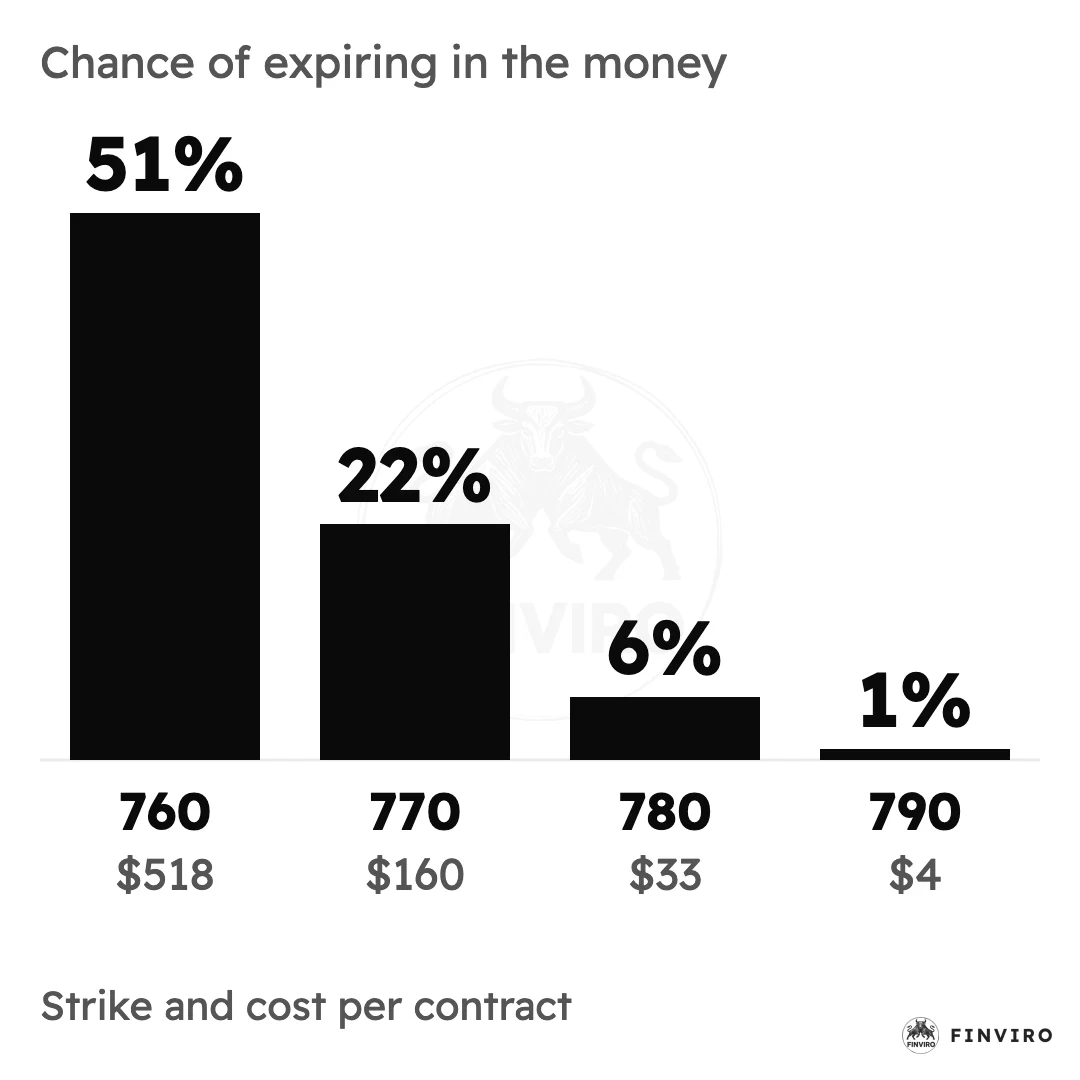
The cheaper the option, the lower its chance of success: calls on SPY at $760, expiration in five days, implied volatility 14%. A worked example, not live prices.
| Strike price | Option price | Cost per contract | Chance of expiring in the money | Move needed to break even |
|---|---|---|---|---|
| 760 | $5.18 | $518 | 51% | +0.68% |
| 770 | $1.60 | $160 | 22% | +1.53% |
| 780 | $0.33 | $33 | 6% | +2.67% |
| 790 | $0.04 | $4 | 1% | +3.95% |
The option priced at $4 needs SPY to rise about 4% in five days for you to get out without a loss. Its chance of expiring in the money is about 1% in this example.
And the cheap one loses faster
An option loses part of its value every day. This decay is measured by theta.
If SPY stays at $760 for one day, the 780 call drops from $0.33 to $0.19, or 43%. The 790 call loses more than half its value.
The far option loses a larger share because its value is all time. None of it is in the money yet.
Three questions before you buy a cheap option
- Where is breakeven? The strike plus what you paid. Work out how far the stock has to move to get there, and in how many days.
- What is the delta? A delta of 0.06 means the option moves about 6 cents when the stock moves a dollar. It is also a quick estimate of the chance of expiring in the money.
- How much does it lose in a day with no move? Compare theta with the option's own price: $0.14 out of $0.33 is more than a third of the option in one day.
What do traders compare instead of the far option?
- A strike closer to the price, in smaller size: it costs more per contract and has a higher chance.
- A debit spread: buying one option and selling a farther one, which lowers the cost and sets your maximum loss before you enter.
- More time: the extra time gives the stock a chance to move and slows the daily decay.
None of these is right every time. What matters is knowing what you are buying: a small chance at a small price.
Summary
- A cheap option is cheap because its chance of success is small.
- The farther the strike, the bigger the move the stock needs and the larger the daily decay as a share of the price.
- Work out breakeven, delta and theta before you buy, not after.
What comes after this lesson?
Next lesson in the series: The stock rose and your option lost: how time eats the premium
To go deeper: delta and theta in the Finviro Academy. And run the numbers on your own option: breakeven calculator.
Try Finviro free for five trading sessions: gamma levels, options flow and the calculators are all open, no card needed. Open your account
The numbers are an example computed with the Black-Scholes model at a 4% rate, not live prices. This article is for learning and is not a recommendation to buy or sell.
