

You bought an option at a price that looked fair. Then the market calmed down, and the option lost a third of its value with the stock where it was. The option was expensive the day you bought it. One number would have told you: IV rank.
Implied volatility is the price of the expected move
Implied volatility (IV) is a number derived from the option price itself. It says how much movement the market expects from the stock. The higher it goes, the more the option costs.
An at-the-money call on a stock at $100 expiring in 30 days. Here is its price depending on volatility:
| Implied volatility | Option price | Breakeven at expiration |
|---|---|---|
| 18% | $2.22 | $102.22 |
| 30% | $3.59 | $103.59 |
| 45% | $5.30 | $105.30 |
| 60% | $7.01 | $107.01 |
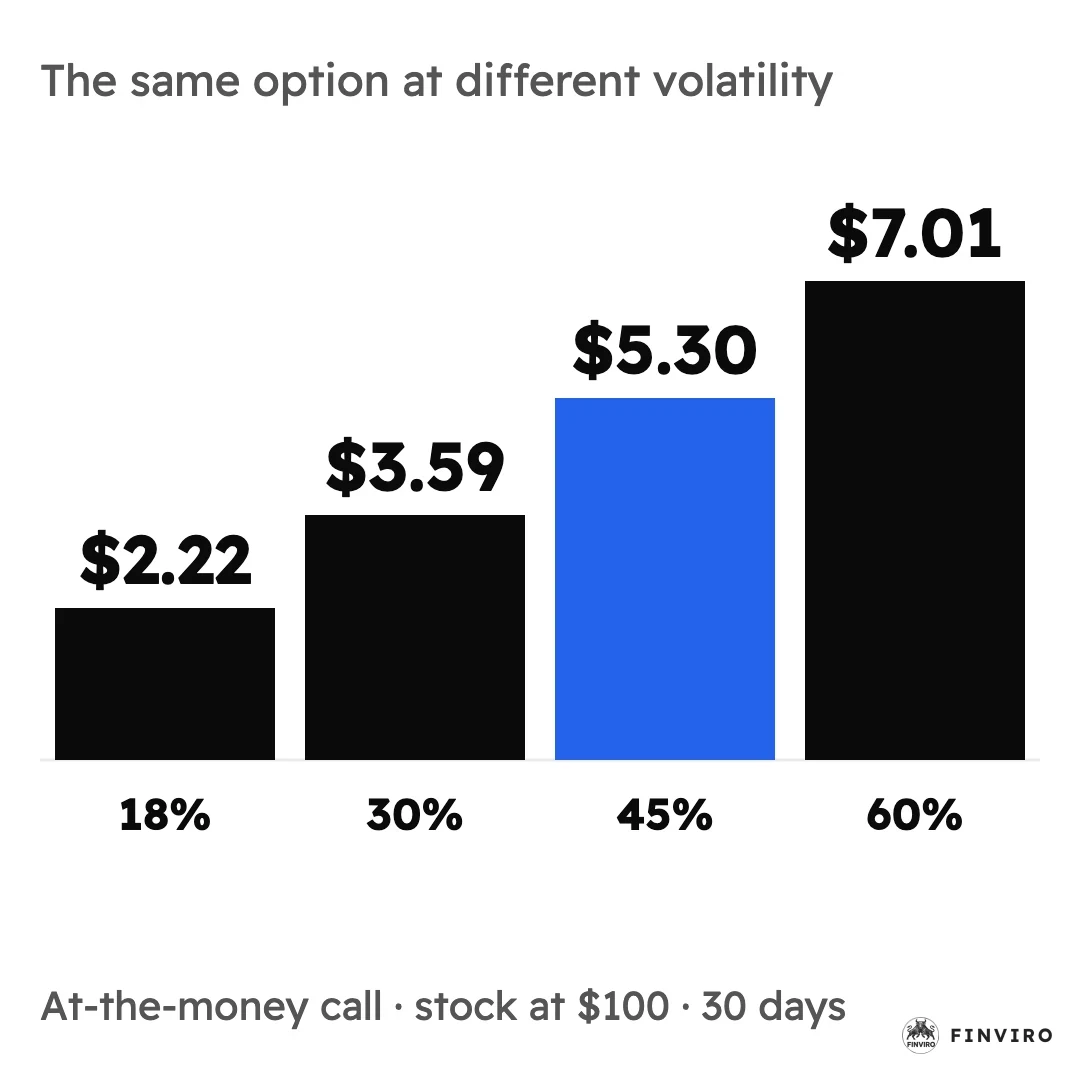
The same option at different implied volatility: an at-the-money call on a stock at $100 expiring in 30 days costs $2.22 at 18% volatility, $5.30 at 45%, and $7.01 at 60%. A worked example, not live prices.
One stock, one option. Yet the buyer at 60% pays three times what the buyer at 18% pays, and needs a bigger move to break even.
IV rank: is 45% a lot?
45% is high for a quiet stock and normal for a volatile one. That is why IV Rank compares the stock with itself, not with others:
IV rank = (volatility now − one-year low) ÷ (one-year high − one-year low) × 100
Example: the one-year low is 18%, the high is 60%, and it is 45% now. Rank = (45 − 18) ÷ (60 − 18) × 100 = 64%. So volatility now is closer to the top of its year than to the bottom.
What happens if volatility calms down?
If volatility drops from 45% to 30% in one day while the stock stays at $100, the option price falls from $5.30 to $3.53, or −33%. This happens often after an earnings report: the volatility crush after earnings.
How do you read the rank?
- Low rank: options are cheaper than on most days of the year. A buyer pays less for the expected move.
- High rank: options are more expensive than on most days of the year. Any calm lowers their price even if the stock stays put.
- Rank does not tell direction: it says how much you pay for the move, not where the stock goes.
Summary
- Implied volatility is part of the price of every option.
- IV rank compares the stock with its own year and says whether the option is expensive now.
- An expensive option loses when the market calms down, even if you were right about direction.
What comes after this lesson?
Next lesson in the series: The 1% rule: how many contracts do you buy before you enter the trade?
To go deeper: vega and implied volatility in the Finviro Academy.
Try Finviro free for five trading sessions: gamma levels, options flow and the calculators are all open, no card needed. Open your account
The numbers are an example computed with the Black-Scholes model at a 4% rate, not live prices. This article is for learning and is not a recommendation to buy or sell.
