

You bought a call on SPY, and the stock rose a full dollar. You opened your account and found the option up only 29 cents. Nobody made a mistake. That number is called delta, and it is the first thing to read before you buy.
What is delta?
Delta says how much the option price moves when the stock moves one dollar.
- For a call it sits between 0 and 1. A delta of 0.54 means a dollar in the stock moves the option 54 cents.
- One contract is 100 shares, so a delta of 0.54 means about $54 per contract for every dollar.
- For a put it sits between 0 and −1: the put gains when the stock falls.
A worked example
A call on SPY with a 760 strike, 30 days to expiration, and implied volatility (IV) of 14%. Here is its delta depending on where the stock is:
| Stock price | Option price | Delta | If the stock rises $5 |
|---|---|---|---|
| $740 | $5.21 | 0.29 | +$1.58 (+30%) |
| $760 | $13.44 | 0.54 | +$2.86 (+21%) |
| $780 | $26.69 | 0.77 | +$3.98 (+15%) |
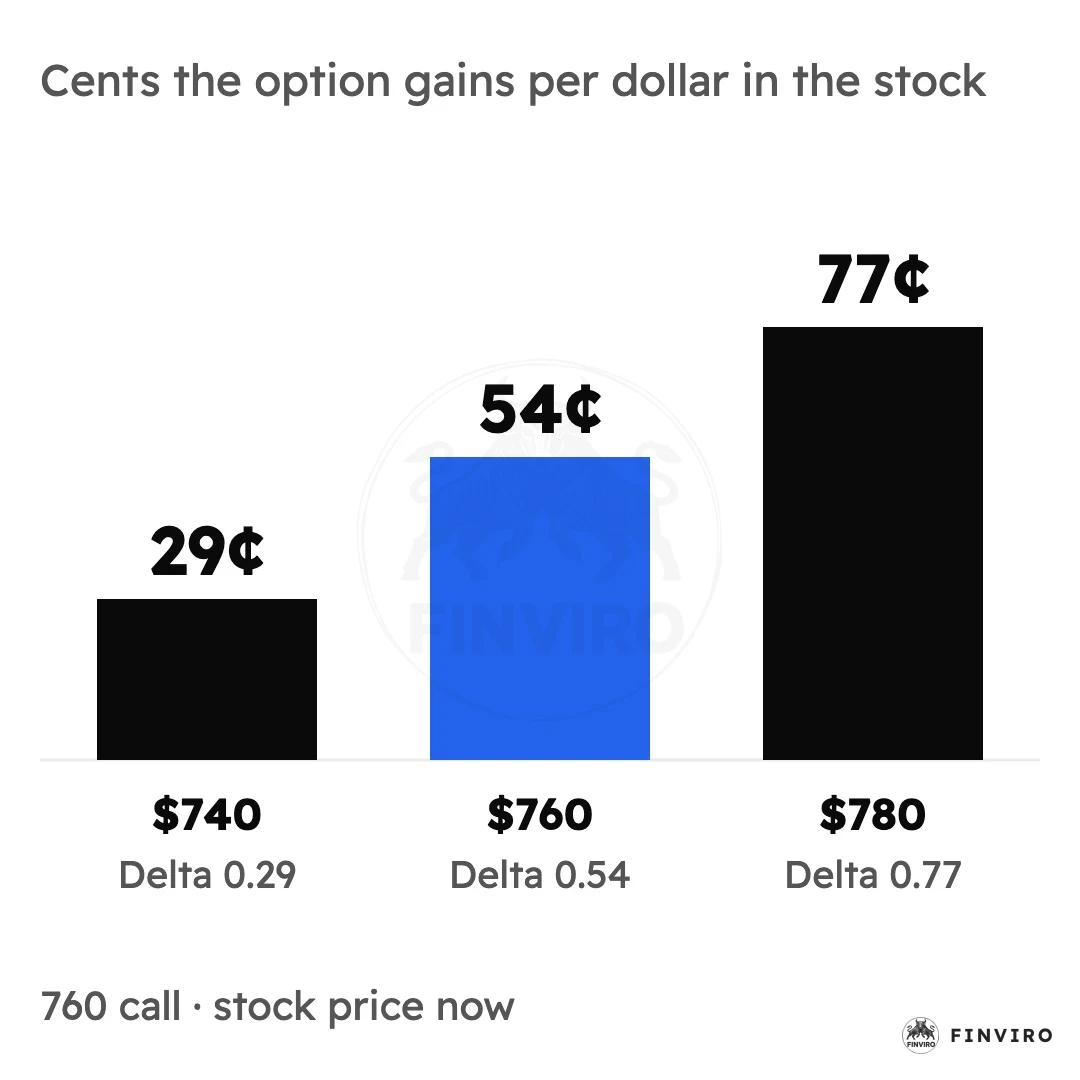
A 760 call on SPY expiring in 30 days: for every dollar in the stock the option moves 29 cents when the stock is at $740, 54 cents at $760, and 77 cents at $780. A worked example, not live prices.
The option far from the price is cheap and its delta is small: it gains a few cents for every dollar. The in-the-money option is expensive and its delta is large: it moves almost like the stock itself.
Delta changes
Delta is not a fixed number. As the stock climbs toward the strike and past it, the delta of a call grows. What measures the speed of that change is called gamma.
Time changes it too: near expiration the delta approaches 1 if the option is in the money, and zero if it is out of the money.
Delta is not exactly a probability
Many people read delta as the chance the option expires in the money. It is close to that for short-dated options, but it is not the same thing. Use it for what it was built for: how much the option moves right now.
Three common mistakes
- Buying a small delta because it is cheap: the option needs a big move before it earns dollars worth mentioning.
- Forgetting that it changes: today's delta is not tomorrow's if the stock moves or time passes.
- Comparing in dollars, not percent: the option in the $740 row gained only $1.58, but that is +30% of its price.
Summary
- Delta says how much your option moves for every dollar in the stock.
- An at-the-money option has a delta close to one half.
- Read delta together with the premium: the cheap option needs a bigger move.
What comes after this lesson?
Next lesson in the series: Expiration date: how much time do you buy with the option?
To go deeper: delta and theta in the Finviro Academy. And work out the delta of your own option: options calculator.
Try Finviro free for five trading sessions: gamma levels, options flow and the calculators are all open, no card needed. Open your account
The numbers are an example computed with the Black-Scholes model at a 4% rate, not live prices. This article is for learning and is not a recommendation to buy or sell.
