

You bought an option, looked at your account seconds later and found it at a loss. The stock had not moved yet.
What you are seeing is the bid-ask spread, and you paid it the moment you bought. On some options it eats a large part of the trade before it starts.
Two prices for every option
Every option in the chain has two prices. The bid: the highest price buyers will pay right now. And the ask: the lowest price sellers will accept.
A market order buys at the ask and sells at the bid. The difference between them is a cost you pay on every entry and exit.
A worked example
An option with a bid of $2.40 and an ask of $2.60. You buy at $2.60, or $260 per contract. If you sold it at the same moment you would get $2.40, a loss of $20 per contract, or 7.7% before any move.
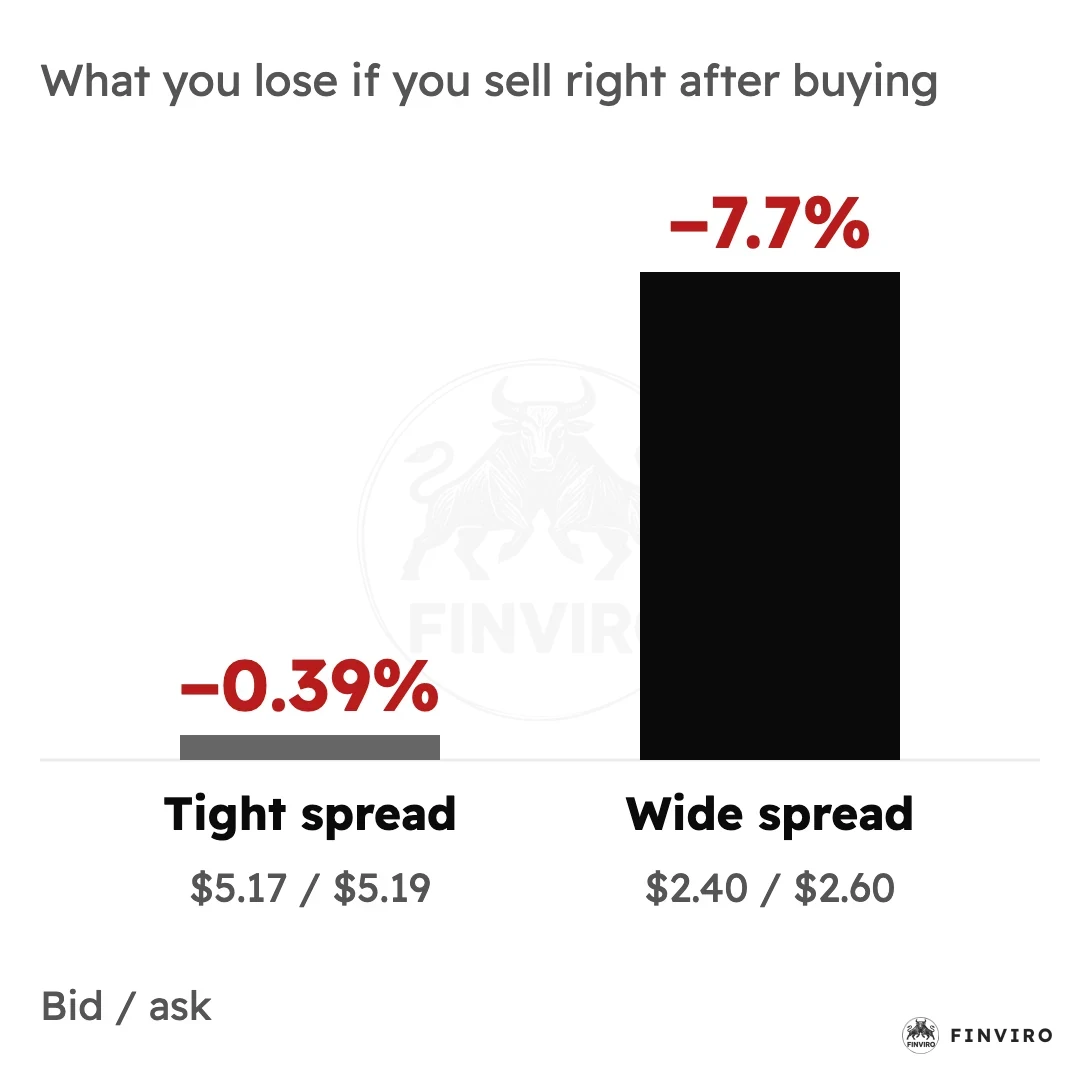
The cost of selling right after buying: 7.7% on an option quoted $2.40 to $2.60, and 0.39% on an option quoted $5.17 to $5.19. A worked example.
On an active option with a bid of $5.17 and an ask of $5.19, the same cost is only 0.39%. The difference between the two options is not the stock. It is the liquidity of the option itself.
How do you read the spread before you enter?
- Divide the spread by the ask: 0.20 ÷ 2.60 = 7.7%. That is how far the option has to move in your favor before you are back to zero.
- Look at volume and open interest: an option that many people trade usually has a tighter spread.
- Compare strikes and expirations: options near the price on large symbols are usually tighter than far ones.
A limit order at the midpoint
Instead of buying at the ask, many traders place a limit order at the midpoint, $2.50 in the example. If it fills, it saves $10 per contract.
It may not fill if the price moves away from it. That is the price of waiting, and it is usually smaller than the price of a wide spread.
Summary
- The spread is a cost you pay on entry and on exit.
- A spread that is wide relative to the option's price eats a large part of any possible gain.
- Read the bid, the ask and the volume before you press the button.
What comes after this lesson?
Next lesson in the series: Breakeven: how far does the stock have to move for you to get out without a loss?
To go deeper: reading the option chain column by column. And price your option: options calculator.
Try Finviro free for five trading sessions: gamma levels, options flow and the calculators are all open, no card needed. Open your account
The prices are a worked example, not live prices. This article is for learning and is not a recommendation to buy or sell.
